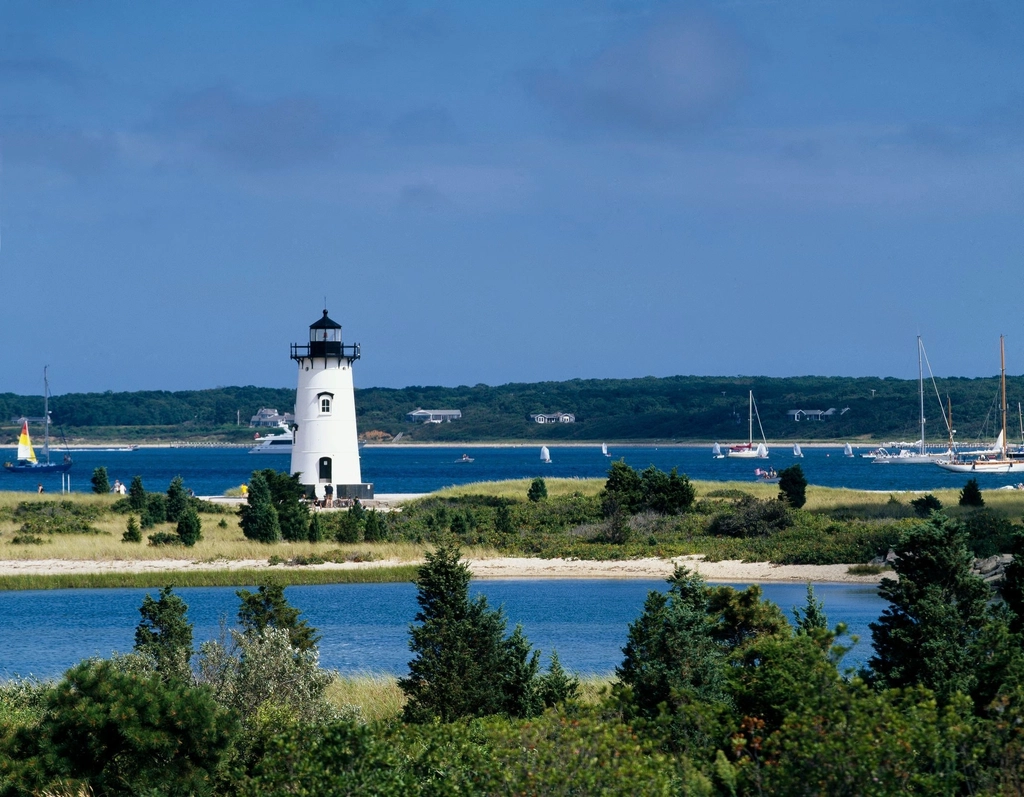
The Granary Gallery’s current star-studded show is a splendid way to end the summer season. The works by Kib Bramhall (b. 1933), Thomas Hart Benton (1889–1975), Heather Neill (b. 1958), Tamalin Baumgarten (b. 1986), and Milton Avery (1885–1965) are stellar examples of their oeuvres. And while not every image is of the Island, the Vineyard is the predominant star.
The iconic and beloved Island painter Kib Bramhall, his wife Tess, and four generations of the family were in attendance at the Granary Gallery for the recent opening. Walking in, you were greeted with a plethora of exquisite oils on canvas by Bramhall, who has, since the 1950s, been capturing the effervescent beauty of land meeting sky and water.
His prowess as a fly-fisherman as well as a painter has always drawn him close to the shoreline. Bramhall lives on Seven Gates Farm with a view of the north shore high above the treeline. His locale allows him to see the intricacies of the sky’s response to sunrises and sunsets over Vineyard Sound.
Gazing at Bramhall’s works, a Zen-like calm comes over us as the perfection lures us into his renderings of the very spirit of a place. We can hear the crunch of the crystalline, light-dappled snow in “Witch Brook,” and imagine standing before the spectacular, warm glow of the sun parting the clouds over the dark ocean waves in “Sunrise.” The enormous, moody expanse of sky fills more than three-quarters of the painting in “Clouds Illusions,” whose poetic title adds resonance to the dance of a dizzying number of blue hues that define nearly the entire canvas.
Bramhall describes his subject as “life at the rim of the sea.” He says, “I try to make my portraits timeless — no beer cans on the beach, nothing but the true essence of the beauty that the artist has seen, nothing that is mutable and everyday.”

“Self-portrait”
by Kib Bramhall
“Resting“
by Kib Bramhall

There is a quietude to Bramhall’s work, which is devoid of human figures, but occasionally nods to a human presence. A single footprint appears at the bottom edge of “Self Portrait,” virtually placing us in the artist’s shoes. The dunes softly undulate back toward the shoreline, lulling our eye to the distant horizon. The six buoys in “Resting” each sit atop a lobster pot, lined up at eye level as we are lying on the ground. These sentinels connect to the artist’s passion and skill as a fisherman. Chris Morse, who, with his wife, Sheila, owns the Granary, Field, and North Water galleries, says, “I’ve worked with a lot of landscape painters, but very few have walked the shores of this Island as completely as Kib has. He has fished every inch of the north and south shore. His record-setting is legendary. Then he gets into his studio and creates these mood-evocative pictorial views of our Island.”
Bramhall invites us to share in his emotional connection to the land and sea of his beloved Vineyard: “You have to look at it this way, and if you do, you’ll see something, feel something, that you may never have seen before.”
There is a treasure trove of paintings and prints by Thomas Hart Benton, one of the founding fathers of the American Regionalism movement, focused on depicting places and faces — mostly from the Midwest and the South in early 20th century America. Every summer from 1920 to 1974, Benton and his family ventured to the Vineyard, like many of his creative contemporaries, including Life magazine photographer Alfred Eisenstaedt. Indeed, you will find two Eisenstaedt photographs of Benton on display — one of the artist on the beach, sketchbook in hand, and another of him at work in the studio, in which we see both the canvas and the model at the same time.
Center stage is the stunning “After the Storm,” which in a single dramatic moment conveys the story of a shipwreck off the Island’s coastline.
Benton was in Menemsha during the 1944 hurricane when this Newfoundland schooner was driven ashore in a gale. He arrived in time to watch a lifeline being tossed to the men still aboard the vessel, one clinging on for life as he dangled over the sea. The boat lists wildly to one side; the ocean roils below, including a giant wave recalling the famous early 19th century Japanese print by Hokusai, appropriately titled “The Great Wave Off Kanagawa.” The intense colors jump off the canvas, heightening the image’s intensity.


Benton said, “The American scene became my subject, and I found it first here on the Island.” Instead of enormous murals representing historical ideas, on the Vineyard, Benton painted his children; the rhythms of the Chilmark landscape, such as the small gem “The Four Brothers,” of mushrooms nestled in the woods; farmers hard at work; and a lovely 1941 painting of the harbor in “Menemsha.”
Heather Neill’s paintings breathe with a life of their own. Each scene is a jewel informed not just by her keen eye, which captures every nuance of color, light, and form, but filtered through her heart. They are an accumulation of experiences and personal associations that create stories we are invited to enter and explore.
Neill paints with a singular, crystalline clarity that draws our gaze to every detail. “The Missing Spindle” speaks to Neill’s intense attention to detail in the interior, and her love of Andrew Wyeth’s work, echoes of which we see in her color palette and in the open fields visible through the window, looking out onto the world. The empty seat beckons us to fill it, sit sipping tea, and stare out at the autumnal landscape.

Neill explains, “The depth of field in that painting was tricky, with a shallow foreground and angled corner cupboard. I spent hours lining up the perspective and lighting the edges to help direct the viewer’s gaze out that window to what originally drew me to that subject … the metal gate. In the reworking, I fussed over that chair a dozen times before realizing that the wide gap on the right was not a drawing error or camera lens aberration, but an actual missing spindle. The teacup came from Jane Slater’s shop in Menemsha; the feather was left for me on the evening walk home from the studio midway through working on this painting … I don’t remember seeing who built the nest, but the [hanging] enameled pot has a permanent resting place on that porch.”
Neill steps back in “Dry Dock,” an enormous painting featuring Little Lady, a historic 1929 wooden fishing boat. It is the last one-person wooden fishing dragger, and is currently being restored by wooden boatbuilders at the Gannon and Benjamin Marine Railway. The turbulent clouds set off the old vessel, adding drama to the scene, moving it far beyond photorealism. Neill writes poetic “Painter’s Notes” for her pieces. A portion for “Dry Dock” says of Little Lady:

Come to rest with her bloomers open to the fresh island breezes for a spell,
she spends her day “down island” for a bit of shore leave.
The comings and goings of the boatyards in Vineyard Haven do have a bit more bustling for her to watch.
But her basin home tucked into the “up Island” village of Menemsha must find a way to cope …
until all her decks have been swabbed
and her yards strung taut
and she can sail away home …
from the Dry Dock.
Tamalin Baumgarten’s spare, dreamlike images relate to her part-time home on Cuttyhunk Island. The breeze seems to caress our face as we stand at the boat’s railing while the sun sparkles on the open expanse of water in “Ferry Crossing.” A realist painter, Baumgarten says, “I believe the ‘real’ part comes from an ability to capture the feeling of a moment beyond just describing in paint what it looks like.” With “In the Evening Light,” we enter the spare interior room, which includes a mysterious shadow of a just-extinguished candle, although we see no humans in the silent scene.


Rounding out the stunning show are several impressive Milton Avery paintings, which, while not of the Vineyard or its surroundings, are quintessential examples of his work. Avery was a master colorist on Cape Cod, and a vital bridge between American representation and abstract painting. He turned everyday scenes into flat, poetic shapes, using bold, unnatural colors to create a sense of depth and emotion. His unique style deeply influenced younger artists who later started Abstract Expressionism.
The exceptional quality of all these artists has influenced, and will continue to influence, artists in the future, but currently offers an overflowing plate of gems.
The Granary Gallery, 636 Old County Road, West Tisbury. For hours and more information, visit granarygallery.com.