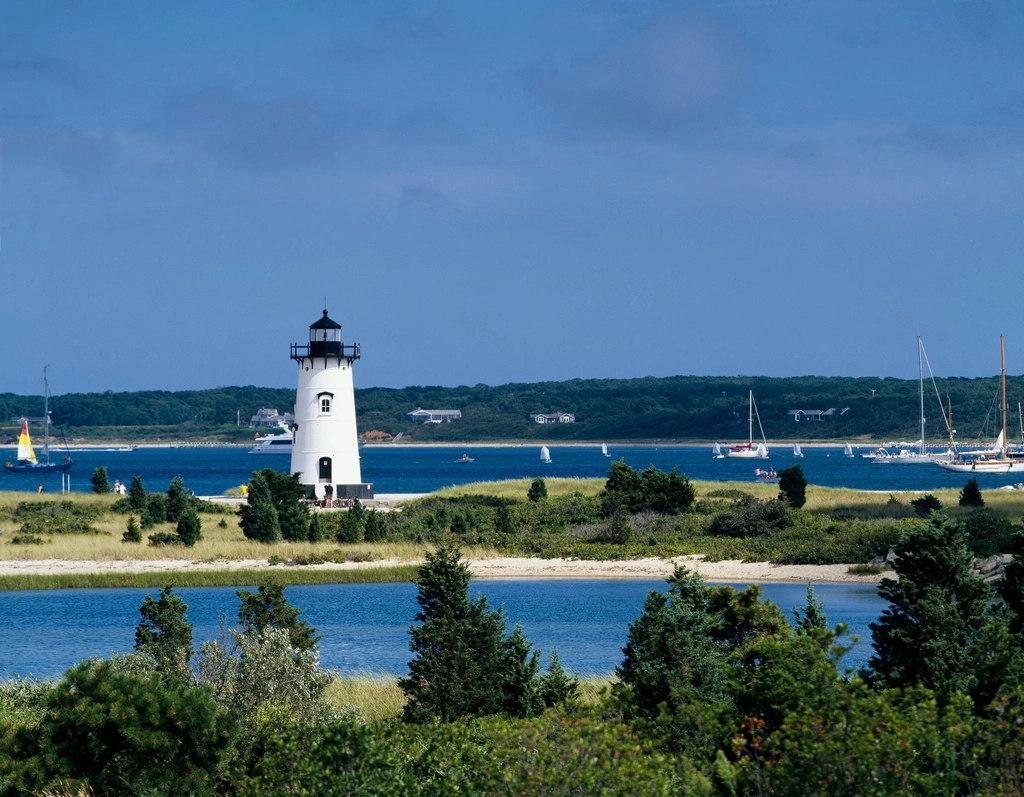
Today marks the beginning of an ongoing series exploring the origins of Island names and places you may have taken for granted for many years. It seems natural, therefore, to start with some of the oldest names here, those in the language of the original inhabitants, the Wampanoag people. Names like Squibnocket (Msquepunauket), Sengekontacket (Sanchiacantacket), and Tashmoo (Kehtashimet) abound throughout Martha’s Vineyard (Noepe). In this first one, we asked Brad Lopes, the tribe’s education director and the Aquinnah Cultural Center’s education and public program manager, to explain the meanings in English of some of the more well-known ones, with others to follow soon. The conversation offers an important and nuanced explanation that explores far more than etymology.
Abby Remer: You told me, “Our language is meant to relate to the land and the waterways. It’s meant to communicate that relationship like a GPS. The words are very descriptive, but sometimes set in time.” Could you elaborate on the latter?
Brad Lopes: It’s tricky, because you have names like Aquinnah (Aquenut/Âhqunah) or Squibnocket (Msquepunauket), which might be translated into “the shore or end of the island/the place where land ends” or “the place of the red cliff or bank,” but there’s more to it. They are all very descriptive. When translated, a lot of the deeper, intimate meaning is lost in that process, though. The true meaning seems to be partially lost in translation. This is complicated by the fact that over time, aspects of some words have been dropped, lost, or corrupted.
But I don’t think any of these names were ever meant to reflect a fixed name across hundreds or thousands of years. The Island’s changed since some of these names were brought forward by our ancestors. So in some ways, if you’re talking about multiple generations ahead, the Aquinnah they know now might appear much different from the one that brought about that name, depending on how ferocious the sea continues to be. At that point then, is somewhere else the end of the Island? So when we are having these conversations [about meaning], these words have become somewhat static, a consequence more often than not of the relationship the non-native public has with tribal nations and citizens. And that’s not how they’re supposed to be.
AR: Can you expand on this idea of the challenges with a name locking a place in time?
BL: Squibnocket refers to a red cliff, or with Menemsha Creek, we’re talking about a winding river. But what if Menemsha Creek dries up? Or the clay erodes into the sea? I think at times, non-native people end up more fixated on names that in other circumstances, our ancestors might have changed and given a new name. There’s a strange historicization and romanticization occurring in these fixations, more often than not. But [for us] it never changes the meaning of that place. It’s not so much about what the name means, but the fact that it’s home. That you belong there, and you want to [keep giving] it names that are appropriate for it over time, reflecting that relationship.
AR: Can you explain what you mean about an assumption and privilege of access to native languages?
BL: Non-native people assume they should have a certain level of access to the language. I think what bothers a lot of native people is that it’s not just translating, which is problematic in its own right. It ignores the fact that for many tribal nations, our language is a sacred thing. [Meaning] is not something that is handed out. And in a lot of cases, tribal nations have been further harmed working with non-native people in this process. For example, many of the Oceti Sakowin (Lakota, Dakota, Nakota) communities first collaborated with the Lakota Language Consortium, founded by two non-native scholars, before discovering the use of copyrighting of materials to essentially sell the language back to them. But it was “owned” by the Lakota people — if we’re going to use that word, “owned.” This can open the door for the same kind of extraction we are pushing back against.
It’s about respecting our wishes around language. It’s about understanding, for instance, why we have language classes that are just for us. At the end of the day, it’s about letting our community decide what occurs with the language. How these place names are shared and understood.
AR: What is essential to understand about what a name of a location means?
BL: A name means what it holds as a value, as a belief, not how it translates. For instance, nutômas means we are from this place, and this place is a part of us. Our blood, our bones, our very being. You’re never unrooted. You’re always a part of this place. It’s a part of you. I think that concept is hard to communicate in English. I don’t think there are English words that capture it.