


The Healer: A Doctor’s Crusade Against Addiction and AIDS by Beny J. Primm, M.D., with John S. Friedman. Published on CreateSpace Independent Publishing Platform. 167 pages, hardcover, $30. 182 pages, paperback, $14.99. Available online at amazon.com, and soon at Island bookstores and libraries.
Read this book, and you may ask yourself why Dr. Beny J. Primm isn’t a household name in our country, given his influential work in changing social and medical history in the turbulent American 20th century.
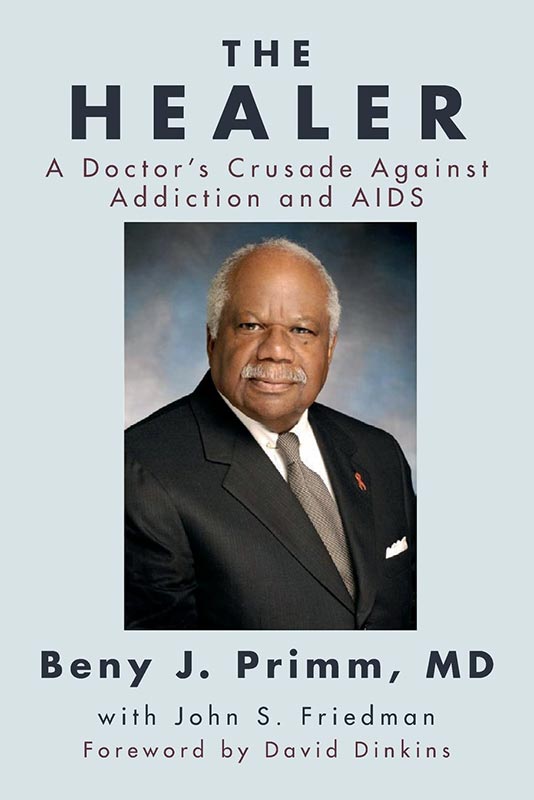
He did the tough stuff: finding means for drug addicts to begin recovery in a world that judged addicts as moral failures instead of people suffering from disease. He began the work on New York City streets in the late 1960s and 1970s, a period of unabating social and political upheaval, which makes his story a remarkable page-turner.
Dr. Primm is also an internationally recognized expert on HIV and AIDS, an area of study he pursued given the relationship between addiction and the epidemic levels of infection among intravenous drug users. He has served on the Presidential Commission on the Human Immunodeficiency Virus Epidemic, and has represented the U.S. at numerous international conferences, including the World Health Organization’s conference in Geneva and the International Conference for Ministers of Health on AIDS Prevention in London. Dr. Primm has advised the National Drug Abuse Policy Office since the Nixon administration.
For 43 years he was executive director of the Addiction Research Treatment Corporation (ARTC) he helped found in 1969 in New York; now called START, it is one of the state’s largest nonhospital providers of health and human services. In 1981, Dr. Primm helped establish the Urban Resource Institute (URI) in New York City. URI supports community-based initiatives and social service programs for battered women, the developmentally disabled, substance abusers, and those infected with HIV and AIDS. “Where you have poverty, you will have lots of other pathologies in a community. Particularly violence to women and children. I started URI to ameliorate some of those issues,” Dr. Primm said in a recent phone conversation with The Times.
Dr. Primm wrote The Healer with John S. Friedman, journalist, documentary filmmaker, and producer of the Academy Award–winning documentary Hotel Terminus: The Life and Times of Klaus Barbie. In The Healer, Dr. Primm describes a Depression-era childhood in bucolic West Virginia, then a cultural fast-forward to mighty DeWitt Clinton High School in the Bronx, a basketball scholarship to the first of two colleges, a paratrooping stint for the U.S. Army, then overseas for a medical degree from the University of Geneva in 1959.
His story reminds us that heroes are people we judge to have risen to an occasion, to meet a crisis or a critical need. History tells us that most heroes aren’t born that way but are prepared by life for their ascendancy.
Dr. Primm came into the world during a three-decade American cultural perfect storm. As a boy in Hatfield-McCoy feud country, he watched the Great Depression unfold, then saw World War II as an adolescent African American living in de facto Southern segregation. As an adult medical professional, he learned to use the social radicalism of the ’60s and ’70s to advance his healing agenda.
Talking with him last week, Dr. Primm discussed his life and work in a gentle baritone ‘doctor’ voice that says “I got this.”
“The times were right. I wasn’t a total radical, but I was radical enough to be embraced by most people involved in all sides of an issue. I was able to get along. My paratrooper training was helpful,” he said without apparent irony.
“It was very, very difficult. I started at Harlem Hospital in 1963 as a weekend emergency room anesthesiologist. Lots of emergency cases. My skills were developed from Friday at 3 pm until Sunday morning. Lots of addiction-related shootings and stabbings. One patient with a gunshot wound to his heart almost bled out. While we were treating him, I noticed scarring on his chest. I asked for his charts, and found addiction history and prior stab wounds.
“I thought, Why didn’t we do something about his addictions? We could have saved him from this injury. That was the moment of clarity for me: Nothing was being done, and something had to be done,” said Dr. Pimm.
That would also be the heroic moment for the new kid at the big city hospital, working the deadly weekend ER shift, who would not keep his mouth shut, and wrote a paper on the need.
“I exposed that at Harlem Hospital. We were serving the drug capital of the world. Finally we started something. I was being heard,” he said.
The “something” at Harlem Hospital was an oversized broom closet for Dr. Primm, his assistant and their files. “Then the [New York] city administration heard me. Mitchell Rosenthal [then with New York City’s Addiction Services Agency] gave me some money to do the work,” he said.
Dr. Primm hired Danny Cook, a street-savvy drug counselor, and it was on: scrabbling for funding, overcoming community objections, and finding a permanent home for the fledgling rehab and treatment agency, managing city and borough political turf wars and the occasional sit-in and/or appropriation of unused buildings for rehab and recovery work.
Ironically, Dr. Primm did his work in the same neighborhood three decades after Alcoholics Anonymous founder Bill Wilson fought the same battles and attitudes to found his AA movement. The cultural issue was the same for both pioneers: Addiction was popularly regarded as a moral, rather than medical, issue. “I think that got in the way, but we had a few people who understood that the moral model was the wrong approach,” Dr. Primm said.
By the late ’60s, the war in Vietnam was not only unpopular at home, but politicians knew they were facing the return of thousands of strung-out soldiers. That problem needed solving, and Dr. Primm found himself on an airplane to Vietnam, courtesy of Jerome Jaffe, the Nixon administration’s drug czar, tasked with setting up in-country drug-testing and assessment of the problem.
Dr. Primm did it, and has been held close by presidential administrations since. He rates George H.W. Bush as the most open-minded president with regard to drug policy, and Bill Clinton as having the most productive drug policies.
Beny J. Primm, M.D.: a man who can talk junkies down and speak up to presidents.
Cousen Rose Gallery on Circuit Avenue in Oak Bluffs will host a public reception and book signing for Dr. Primm, an Island seasonal resident for more than 50 years, on August 22 from 7 to 9 pm.