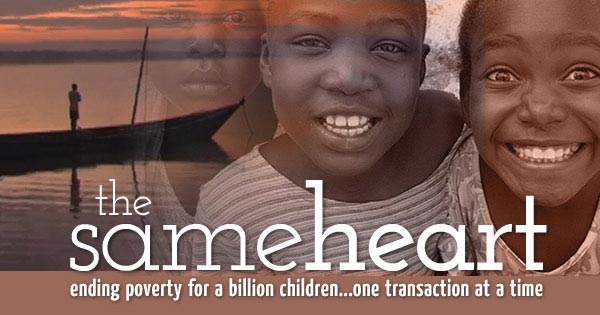
This Friday, March 20, at 4:30 pm, the Martha’s Vineyard Film Festival will screen The Same Heart, a documentary exploring child poverty that was made by Galen Films of Vineyard Haven. After the film, Galen Films documentarians Georgia Morris, Len Morris, and Petra Lent, will hold a discussion with the audience. Through email, The Times asked a few questions of its own ahead of the screening.
How long did it take to make the film?
Len Morris: The first shoot for the film was in 2006 at a Millennium Village in Sauri, Kenya. We were working on other projects and shooting intermittently in Rome and New York and Atlanta [for Nobel laureate interviews], and then back to Kenya. We began concentrating exclusively on The Same Heart in 2010 — so it’s taken five years in all. We expect the distribution will involve another two years.
What was your motivation for choosing the film’s subject?
Len Morris: The subject of poverty and the impacts of inequality on children here in the U.S. and around the world came directly from our experience making Stolen Childhoods (2005), on global child labor, and Rescuing Emmanuel (2009), about street children. With each of those films, we saw over and over the unmet needs of children and the results of a broken aid system that essentially provides too little funding too late.
We wanted to highlight these unmet needs, examine the aid system and propose a different way to raise the resources needed for children’s basic needs: food, health care, education, clean water, sanitation, shelter, and security. This led us to the financial transaction tax (FTT, also Robin Hood Tax) which is at the heart of the film. The film has many positive ideas for helping children, but the FTT has the potential to be a real game changer. Imagine a world where antiretroviraldrugs are free to all children who are HIV-positive, instead of our system today, where one child in five gets the life-saving drugs they require. The funds raised through an FTT will help prevent the deaths of millions of children every year from wholly preventable causes.
Has the late Robin Romano’s [photojournalism] work influenced this film?
Len Morris: Robin’s work suffuses the film. Ninety-five percent of the still photography in the film is Robin’s, and footage from Liberia, Panama, Mali, Nepal, and Afghanistan was shot by Robin. What’s different about The Same Heart is that we used moments where children act like children, at play and in the casual moments, and also in their reactions to being filmed … we felt the children make their own best argument, and so we used those moments and found them abundantly, in every country. No matter how poor a child is, their resilience shines through. Robin saw this and celebrated their spirit and beauty through his photography.
Petra, could you describe your role in the filmmaking process and what you’ve found rewarding about it?
Petra Lent: We’re a tiny group, and I’ve worked as a producing partner with Len and Georgia for close to 30 years. At this point, we’ve worked together for so long that we finish each other’s sentences. My work on the film ranges from research on the initial idea to distribution, soup to nuts. Sitting in the editing room is where the film really happens, and that’s the part of it that I enjoy the most.
Len, what challenges did this film present for you as a director?
Len Morris: This film is about a lot of very serious stuff; my greatest challenge was to find a way to present it without crushing any sense of optimism or desire to help the audience brings to the topic. People care about children in every country, and I wanted to take that most basic human impulse and find a way to harness it for good. So much of what is needed can’t happen without a consistent flow of aid to pay for food, medicine for diseases we have cures for, and education. So I want to offer a path for change … the goal would be to make my own films obsolete.
Georgia, what challenges did this film present for you as a writer?
Georgia Morris: We made this film over a period of years in various cultures. I was dealing with transcripts of poor children, Nobel laureates, world economists, grandmas raising AIDS orphans, philanthropists, people protesting in the streets. It was quite a rich pile of ingredients to cook with, but I had to keep focusing in on the message, while being true to each voice. It was a fun challenge.
Len, how did the elements affect production?
Len Morris: Shooting in Africa brings its surprises. One day the heavens opened with torrents of rain, and we learned the power of mud. The van literally slid off the road. We got out to push and sunk to our ankles; the van sunk to its axle. And somehow the locals stayed relatively clean, while we yanked on the same ropes and looked like the mud men of Borneo. Hours later at the street market in Kisumu, a bucket brigade of kids capitalized on our disaster, making a king’s ransom washing our precious boots and socks. Sometimes capitalism works like a champ.
Georgia, can you recall any moments of surprise during production?
Georgia Morris: The time we came up over a hill to film a birth celebration in a remote village, and because I was the only woman on the crew and the ladies were lying in wait, before I could see what was happening a grandma threw a kanga cloth over me and pulled me into the women’s dance, handing me the baby to bounce up and down over my head. I was stunned with the privilege, touched, giddy, and scared out of my wits. What crumbled that day was the cultural wall that I was sure would always separate us. We were just women dancing with hope for baby Ivy.
What do you hope this film will achieve?
Len Morris: As Nobel laureate Mairead Maguire of Ireland says in the movie, ” Everybody can do something to make the world a better place for children,” and we’re hoping that first and foremost the film will help the campaign underway to adopt the FTT, which would generate billions of dollars every year that can be used to meet the unmet needs of children in the U.S. — where 17 million kids live in poverty — and around the world, where 1 in 2 children go to bed hungry.