


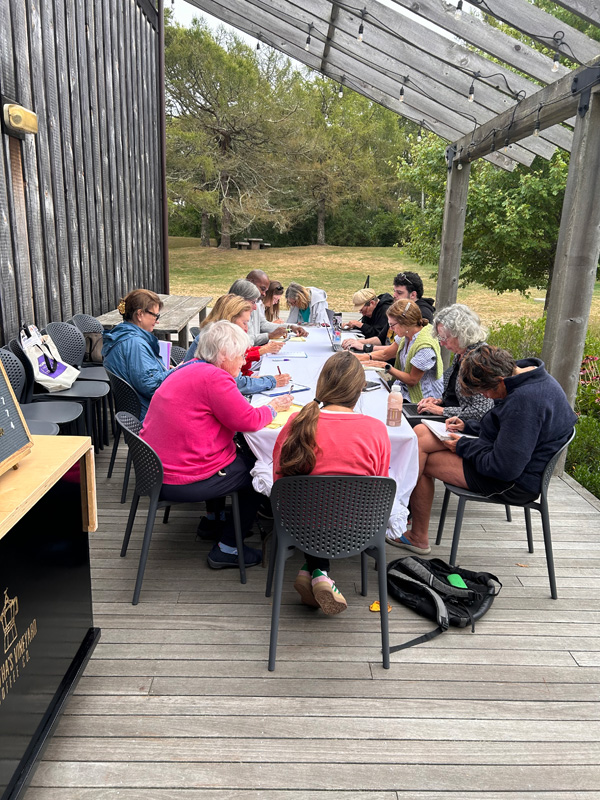


Islanders Write, the two-day celebration of writing and writers, brought together authors, journalists, and academics from across the country — each with a special tie to the Island.
After Sunday evening’s kickoff, the grounds of Featherstone buzzed with energy Monday as guests gathered for panel discussions where speakers shared their time, expertise, and insights. Attendees filled rooms to hear about the craft of writing, attend workshops, connect with favorite authors, and take home books from the Edgartown Books pop-up, where every featured writer was represented.
The day began with a welcome from MV Times Publisher Charles Sennott, who emphasized the vital role of local journalism in today’s media landscape, setting the tone for a program rooted in storytelling, community, and the written word.
Following Sennott’s remarks on reliability and transparency in reporting, the first panel turned to an adjacent question in literature: What is an unreliable narrator? Moderated by Kate Feiffer, the discussion featured James Jennings and E. Lockhart.
Lockhart is the No. 1 NY Times bestselling author (YA paperback list) of “We Were Liars,” which has recently been adapted into a TV series. Though Lockhart’s psychological thriller is often cited as a classic case of the unreliable narrator, she pushed back: “I understand why people feel like my narrators are unreliable, but I don’t think that they are, they’re telling you what they know,” said Lockhart. Instead, she describes her book as an amnesia story: The narrator is being completely honest with the reader, but critical information is missing.
James Jennings agrees with this sentiment. “How reliable can you be if you don’t know the truth?” he asked. His novel, “Wings of Red,” is autobiographical fiction he wrote as he was experiencing homelessness in NYC. “It was written in such a hyper-realistic state, written in a desperate state of my brain trying to understand itself,” he said.
The panel on shaping history into story explored the balance between fact and imagination, bringing together biographer Meryl Gordon, playwright and children’s book author Richard Michelson, historical novelist Dawn Tripp, and screenwriter Misan Sagay.
“This is about how and why and when we make decisions,” said Sagay, setting the tone for a candid conversation on the craft of shaping real events into story, and promising to get into the “nitty-gritty.”
For Tripp, it often comes down to what she called “the telling detail” — the small moment that makes the past leap vividly to life. Gordon, by contrast, said she often finds inspiration in offbeat news items that reveal something unexpected about her subjects.
The panelists wrestled with the challenge of writing about real people. “Life is long, a book is short,” Michelson said. “No matter how careful you are, you’re shaping a narrative through a certain lens.”
Sagay put it more starkly: “When I write about real people, I am setting sail through a boat full of liars. They want me to remake the world not as they lived it, but as they wanted it to have been.”
Their processes vary as widely as their perspectives. Uniquely, Michelson researches exhaustively, then sets his notes aside for six months before writing, trusting that what stays with him will resonate most with readers.
Different methods, same dilemma: how to honor the facts without being trapped by them. “It’s the details that pull you in, but it’s the emotions that make the story last,” said Tripp.
Literary agent Adriana Stimola moderated a lively discussion with Jessica B. Harris (“Braided Heritage”) and Julia Blanter (“The Martha’s Vineyard Cookbook),” asking what might appear a simple question: What is a cookbook, and what should it do?
Both writers agreed that recipes alone are not enough, and storytelling is essential, capturing the context of the ingredients, the history of the meal, and the people behind it. Blanter’s book profiles Vineyard locals, while Harris traces the intertwined culinary traditions of Native American, African, and European cultures, particularly those of France and Spain.
The panel touched on the practical realities of publishing, contrasting the U.S. and U.K. markets. In the U.S., editors often assume readers need detailed instructions, while U.K. publishers expect a higher baseline of cooking knowledge. Blanter recalled the debate over the cover of her Vineyard cookbook, when her publisher initially rejected her design in favor of something that looked “more like what people think the Vineyard looks like.” She and her team fought back, and won.
Harris nodded knowingly, recalling her own experience of having to insist on keeping the word braid in the title of her book after it was dismissed by “white guys in a room — what do they know about braids?”
Both writers confessed they rarely follow recipes exactly, even their own. For them, the deeper meaning of a dish helps cooks improvise and add their own personal flare. Harris hopes that her recipes can serve as a springboard, where food becomes a pathway to connection and growth.
Paul Karasik walked the now hungry audience through his graphic novel “The New York Trilogy.” Karasik is a two-time Eisner awardwinning cartoonist, and has been published in the New Yorker, the Washington Post, and the Boston Globe.
Karasik spoke about the work of a cartoonist, and shared a few images of his work, including a cartoon of a human couple sitting across from a robot couple. The caption accompanying the cartoon reads, “We’ve both been here before, so we’re taking things slow.”
“The New York Trilogy” pays tribute to Paul Auster, an American writer, novelist, poet, memoirist, and filmmaker. It is postmodern literature as noir fiction, where language is the prime suspect. Each book explores various philosophical themes. In “City of Glass,” an author of detective fiction investigates a murder and descends into madness. “Ghosts” is about a private eye named Blue, trailing a man named Black, for a client called White. This too ends with the protagonist’s spiral down. And in “The Locked Room,” another author is experiencing writer’s block, and hopes to break it by solving the disappearance of his childhood friend.
The pitch panel on publishing brought together industry veterans to hear — and advise — emerging authors. The panel included Torrey Oberfest, a partner at Bloomvale who counsels publishing companies on growth strategies; novelist Nancy Star; editor Gretchen Young; and literary agent Rosemary Stimola.
The session gave writers an opportunity to present their book ideas directly to experts, gaining insight on how to refine their projects and move them closer to publication.
Mel Thompson pitched a young adult novel exploring DNA, memory, and human coexistence with AI. Her protagonist grapples with trauma and memories embedded in his genes.
Deborah Hammett shared the story behind her self-help/travel memoir. At 60, she sold everything, bought a sailboat, and began life as an ocean nomad. “I want to show 60- to 90-year-olds what they can accomplish,” she said, “and that they are never too old to change or assert themselves.”
Tara Simmons closed the session with a pitch for a novel set on a small Island at a men’s correctional center. When a prisoner escapes, her protagonist, Kate, is blamed, forcing her into a dangerous chase that leads to an unexpected twist.
During the panel discussion about historical fiction, three bestselling authors, Nicole Galland, Martha Hall Kelly, and Geraldine Brooks, shared stories and their passion for prose and research.
The writers spoke candidly about the research that fuels their fiction, and the responsibility of making the past resonate with today’s readers.
“It’s the spaces where the voices fall silent, that’s where the fiction is for me,” Brooks said, and clarified she uses the true history every time it’s available. “It’s emotions that shape us, and those emotions are in common, I think, among us,” and through time.
Galland brought up the conversations about social justice issues that happen in her book “Boy,” and said part of her process was tapping into the differences and similarities between the issues society is having 400 years later. Those discussions back then, she said, were the precursor to now, and it’s those connections that make historical fiction so continually relevant. But now, she said, she had to keep in mind: “We’re writing to a modern audience.”
“The constant challenge with historical fiction is keeping it current,” said Kelly.
“This is what we do,” Brooks said. “We put ourselves in somebody else’s shoes.”
Wrapping up the panel discussions for the day was a performance by some of the Islands’ best-known singer-songwriters, followed by a conversation about their inspiration and process. Kate Taylor, Jemima James, John Forté, and Willy Mason each performed an original song before launching into discussion, which was moderated by Polly Simpkins.
For some musicians, like Mason and Taylor, music was ingrained in their everyday lives. It was the way they found connection with their family and friends, and the way they discovered themselves more deeply.
“For me, music was always made available if we wanted it, and it was the only way you could get a word in edgewise,” Taylor said with a smile. “As a generation, it was the mechanism with which we communicated with each other,” she added.
Forté said he had a different experience with music early on. Now his career is about collaboration with other people, but it started as an escape, away from the world and into a safer, inner way of being.
“What couldn’t be stolen or taken away from me was the time that I could spend practicing scales on the violin,” Forté said. “Creating in that way, for me, felt more like a lifeline than it did a recreation. There’s a voice, there’s authorship, there’s ownership, there’s empowerment.”
All the songwriters said they pulled from their own lives, were inspired by historic and current events, and experienced all different states of awareness when it came to their writing process. Many of them have been writing songs since their childhood or teenage years.
“For me, it’s about finding a way into the idea,” Mason said. He said he likes to ground into the moment and his tactile environment — “so that I don’t just wander off into the abyss of ungrounded ideas,” he continued. “Those moments of reality become a mirror through which I can look at the ideas I’m trying to put into words.”
Following this concluding panel, attendees trickled out of Featherstone with canvas tote bags filled with new signed books, their notes from the day, and a sense of inspiration and encouragement gathered from the creative community around them.
