


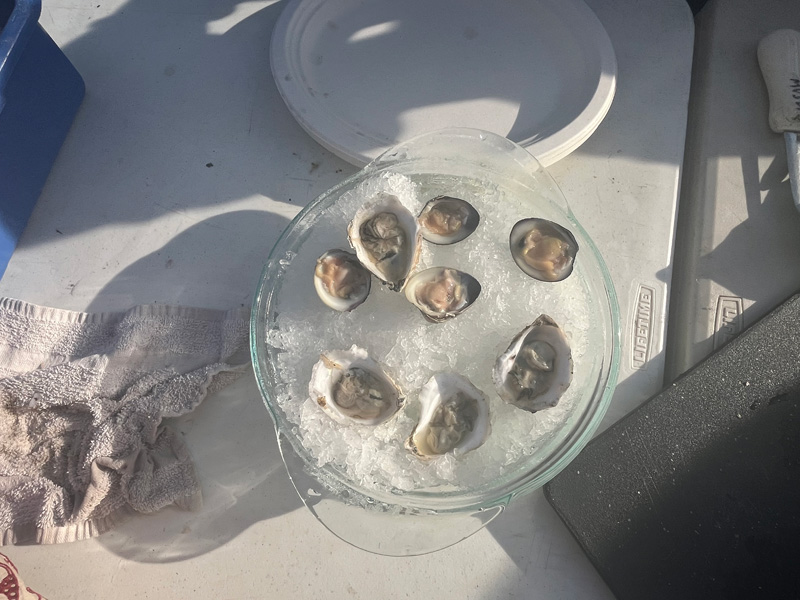
On a wooden platform outside of the Martha’s Vineyard Agricultural Society’s (MVAS) Main Hall in West Tisbury, professional and amateur shellfish shuckers deftly sliced open littleneck clams and oysters. Shells spilling onto the ground and bits of inner matter flying through the air, the spectators cheered under the Saturday afternoon sun during this year’s MV Agricultural Fair’s annual Shucking Competition.
It wasn’t just the excitement and drama of the shucking contest that bivalves made their presence known at the fair. Following the competition, the Martha’s Vineyard Shellfish Group led an all-ages shellfish shucking workshop and demonstration on how to safely and effectively shuck clams, scallops, and oysters.
Oyster knife in hand, MV Shellfish Group Executive Director Emma Green-Beach highlighted the uniqueness of each oyster.
“Every oyster is shaped a little bit differently. They are their own puzzle, which is what makes them fun and challenging,” Green-Beach said to fairgoers.
At the Ag Fair, where it can feel the main focus is hone in on more on terrestrial, traditional farming, Green-Beach and others are working to incorporate more of the blue economy — oysters, clams and other aquaculture. And Saturday’s workshop is a part of the nonprofit’s wider efforts to engage the Island community with aquaculture. Defined as the rearing of aquatic animals or the cultivation of aquatic plants for food, it can be the sometimes forgotten aspect of agriculture.
Ag Society program and outreach manager, Lucy Grinnan, said that although the fair and Society may primarily focuses on terrestrial agriculture, they also try to incorporate aquaculture farming into their general programming, such as through shellfish hatchery tours and farmer grant writing workshops.
“We try to involve aquaculture in our community of farmers,” she said.
There’s also an environmental push behind raising awareness around aquaculture, with bivalves helping to clean local waterways of nitrogen. For Green-Beach, she believes that people are more inclined to care about environmental issues, such as the reduction of nitrogen, when they have a close relationship with their local ponds.
”That connection is important when we have the choice to protect the ponds or not,” she said.
Along with the workshop, MV Shellfish Group also set up a touch tank on Thursday, which consisted of two glass baking dishes filled with water. One of the dishes was designated for predators, such as starfish, hermit crabs, spider crabs, green crabs, and Jonah crabs. The other dish housed filter feeders, like clams, scallops, and oysters.
Green-Beach said that the touch tank allows MV Shellfish to educate people about marine organisms in a hands-on way.
“What we can bring is a really unique opportunity to bring the saltwater and the marine creatures to all kinds of different places.”
The group also created a display inside of the Main Hall for their 4-H group, Seashore Explorers. Since 2023, Green-Beach and MV Shellfish Group education and outreach manager Nina Ferry Montanile have led their club as part of Ag Society’s 4-H programming, which was revived in 2018 after a decades-long hiatus on the Island.
The exhibit consisted of miniature sculptures made from scallop, oyster, and clam shells created by the children in the group. Nicknamed “reef balls,” these sculptures were set into an aquatic tank with baby oysters placed on top of them. Green-Beach said that she wanted the display to both showcase the children’s participation in 4-H and educate about the ecological significance of oysters.
“We were trying to demonstrate not only the involvement of the kids and the way that oysters and oyster beds promote biodiversity and clean the water,” she said.
However, Green-Beach feels just as enthusiastic about teaching adults.
“It’s just as fun to see the look on adults’ faces who have never seen the sparkly blue eyes of a bay scallop,” she said.
Green-Beach, who refers to aquaculture as “farming the sea,” said that although many people don’t initially associate shellfish cultivation with agriculture, they’re more inclined to after receiving hands-on experience with MV Shellfish Group, such as during hatchery tours.
“People don’t make a connection at first until they talk to an oyster farmer,” said Green-Beach.
The group also launched a pilot initiative with the towns of Edgartown and Tisbury last year for educational shellfishing permits. The free program allows the group to take people out shellfishing who are unfamiliar with it.
”If you didn’t grow up shellfishing, it can be an intimidating process,” said Montanile. “[The educational permits] get people out on the water while also emphasizing that it’s important to have a license.”
Green-Beach underscored the role of shellfish in the Island’s local food system.
“The aquaculture industry is absolutely part of that. We have a whole other sector of farmers growing food for us in the water that we need to be able to take advantage of,” she said.
Green-Beach called for community engagement with shellfish and their aquatic environments.
“We need people to continue to connect physically and emotionally with the water and with the shellfish resources that are at the tips of everyone’s fingers,” she said. “If we stop playing in the water and recreating and eating from our coastal ponds, then we’re going to lose that connection spot.”
