


News analysis:
The answer from longtime residents of Martha’s Vineyard is often a shrug of resignation. Still, the question persists: Why are gasoline prices on the Island so much higher than on the mainland?
Big Oil must be the culprit — a rapid-fire assumption. Not so. Big Oil owns less than 4 percent of the country’s 150,000 retail gasoline stations, and it manages only one-third of the ones it does own, according to the National Association of Convenience Stores, which represents convenience and and fuel retailers (NACS). Big Oil has stepped out of retail to concentrate on exploration and production. The overwhelming majority of retail stations are independently owned and operated.
Island station owners are also tired of being asked the question. “You must be new,” muttered one irritated owner to a Times reporter, alluding to the near-annual article about gasoline prices (apparently always assigned to cub reporters).
So, what is the answer? Volume, volume, and again, volume. The Island market for gasoline — for any product or service, in fact — is very small. It is also an isolated market, and markedly seasonal.
Seasonality is a factor
Transportation costs drive up the price on everything imported from the mainland, and the short season means a very uneven revenue stream.
“June 15 to Columbus Day is the season that accounts for 75 percent of the year’s sales,” said Michael Rotondo, owner of Airport Mobil, a comment echoed by other dealers. “The station operates at a loss beginning mid-January, and continues in February and March, because landscapers and tradesmen aren’t moving around as much.”
There are nine gas stations on Martha’s Vineyard. No station owner was willing to divulge yearly sales volume. However, the total for all gasoline retailers was about 6.267 million gallons to 6.767 million gallons last year, according to an estimate by Ralph Packer, owner of R.M. Packer Co. and Tisbury Shell, and one of the Island’s most knowledgeable fuel suppliers.
Mr. Packer, whose barging operation and shoreside facilities once accounted for all Island fuel supplies, estimated that between 7 million and 7.5 million gallons of gasoline were sold last year by all Island retailers, including jet fuel sold at the airport.
Sean Flynn, airport manager, seconded Mr. Packer’s estimate, and said the airport sold 733,000 gallons of jet fuel in 2014. Subtracting that figure from Mr. Packer’s estimate for all retail sales gives the estimated total for the nine stations, leaving an annual average of well under 1 million gallons per station per year.
By comparison, the Gulf station at the Bourne Bridge rotary sells about 11 million gallons a year, said Manager Amadou Kaba. His volume, too, fluctuates by the season, as tourists flow on and off the bridge and drivers come and go from the Vineyard.
Volume equals price
Price is all about volume. On April 3, the rotary Gulf station was selling regular gasoline at $2.30 a gallon. The same day, on the Vineyard, prices ranged from $2.79 to $3.19 per gallon. The lowest price of $2.79 was, surprisingly, at the distant Menemsha Texaco station. At the down-Island Shell and Citgo stations in Vineyard Haven, the price was $2.99, as it was at the Up Island Automotive (Mobil) station in West Tisbury. In between, in Oak Bluffs the Mobil station was selling at $3.06; Phillips 66 at $3.09. Airport Mobil priced regular at $3.09; Edgartown Shell at $3.15, and Edgartown Mobil at $3.19.
Why gasoline at the remote Menemsha outpost was selling well below all other Island stations was not clear. Perhaps it was intended as a magnet for the few drivers up-Island on an early April day, or an effort to clear out the tanks before the obligatory “summer blend” arrives. Owner Marshall Carroll declined to be interviewed for this story.
The station operates on a town-owned harbor lot, one of a number of lots leased at well below market rates in order to maintain the town’s fishing industry. The rent is less than $2,000 annually.
Ordinarily, the closer to heavily populated areas, the more the price per gallon drops, as volume and competition increase. Higher volume offsets the lower unit price. When hyper retailers like BJ’s, Sam’s Club, or Costco enter the game, the price drops even more. On April 3, BJ’s was selling regular gas at $2.12 to $2.25 a gallon, depending on its Massachusetts location. In Boston, prices could be found even a few cents lower at unbranded stations.
Gasoline pricing is complex, volatile, widely misunderstood, and not the same for every retail station, whether selling a refinery’s brand or not. What’s behind all the intricacy? Multiple factors. Where the retailer buys his gas, the terms of his contract, how the gasoline is delivered, and his station’s overhead all play into the final price.
“It’s like playing futures,” Michael Rotondo said.
The breakdown
The U.S. Energy Information Administration (EIA) breaks down the retail price into four major cost components, which in November 2014 were: crude oil (65 percent); refining (6 percent), taxes (15 percent), and distribution and marketing (17 percent). By February 2015, as the price of crude continued to fall, EIA revised crude oil’s share in the retail price to 51 percent, thereby shifting larger percentages to the other three components.
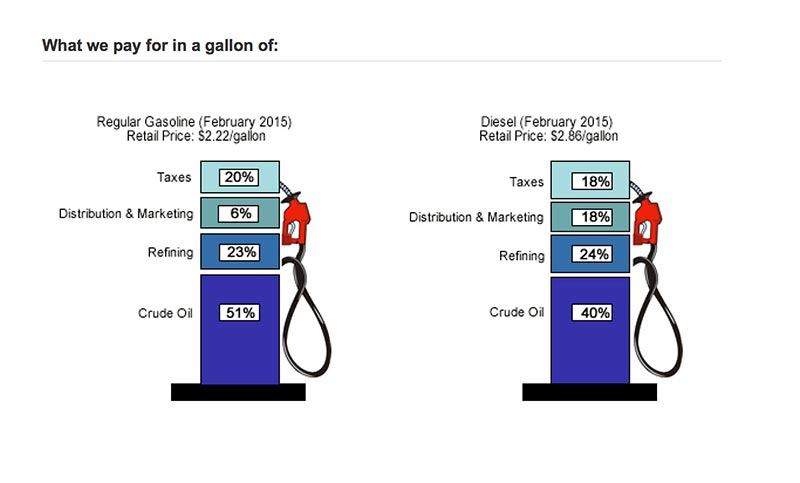
The component most vulnerable to sudden price fluctuations is crude oil, the raw material, because its price is determined solely by global supply and demand. Over the past year the price of crude has plummeted, largely due to increased North American production. Supply exceeded worldwide demand. However, various energy-tracking organizations point out that the price could increase if weather, social unrest in oil-producing countries, or terrorism disrupts supply, or decrease if China’s economic growth slows, Saudi Arabia’s output remains constant, or sanctions on Iran are lifted.
When the price of crude oil changes, what should we expect at the pump? A drop in price immediately prompts expectation of an equivalent drop at the pump. Too many other variables dash that hope. A rough calculation — note, rough — by NACS is that for every $1 change in the price of a barrel of crude oil, the retail price will move approximately 2.4 cents per gallon.
Wholesale prices at the fuel terminal — Providence, R.I., for most Island retailers — vary by volume and refinery brand. The wholesale price at the terminal has built into it the cost of crude oil, refining and taxes, both federal and state.
In Massachusetts, that means the wholesale price includes 45.4 cents per gallon (cpg) in state and federal taxes; 18.4 cpg in federal excise tax; and .26.64 cpg for the commonwealth. The Massachusetts tax includes a 2.54 cpg underground storage-tank fee, intended for fuel cleanups (but often used for the MBTA, according to John Quinn, executive director of the Massachusetts Petroleum Council).
Island factor
Where mainland and Island prices begin to diverge is in the post-refinery costs — distribution/transportation and marketing. Again, plenty of variables. Does the retailer pick up his own gasoline, or is it delivered by a “jobber”?
Only Ralph Packer, owner of Tisbury Shell, can pick up his own, by fuel barge usually, with his own truck occasionally. A.J. Noonan, one of two jobbers that deliver to Island stations, bases its delivery cost on volume and distance traveled to obtain the gasoline, which could be Providence, New Haven, Portland, Boston, or New York, a company spokesman, who asked not to be identified by name, said.
A single delivery cost is difficult to pin down. Fuel trucks have a 10,000- to 12,000-gallon capacity, divided into compartments, usually five, enabling the jobber to carry different types of fuel (regular, premium, on- or off-road diesel), and different brands, all in the same delivery run. During the off-season Island retailers may have deliveries two or three times a week, but in the high season they require daily deliveries.
Bob Raso, who drives for Macera & Martini, the other jobber, said his company charges a flat fee for fuel delivery to the Vineyard, although he does not know what the fee is. Whatever the cost basis for the delivery, “it’s expensive,” he said.
“I load in Providence at 3 am, drive to Woods Hole, where I wait an hour or more for the Hazmat [freight] ferry, make my deliveries, wait another hour or so for the ferry back to the mainland. By the time I’m back on the mainland, there is time for perhaps one more delivery after I fill up in Providence.”
Working on the mainland, he can make “many deliveries in a day.” Downtime is expensive, noted the A.J. Noonan spokesman. “We load on Saturday for Monday deliveries, and if the ferry isn’t running, the cost rises substantially,” he said.
Owning his own fuel barge — the only one in New England — gives Ralph Packer a cost advantage in the transportation equation when he loads up at the New Bedford marine terminal. The barge has a capacity many times greater than that of a fuel truck; what’s more, the barge only needs 12 hours for a round-trip to New Bedford, whereas a truck out of Providence can make only one trip in twice the time.
In recent months, Mr. Packer’s Tisbury Shell has relied on truck deliveries — either from A.J. Noonan or his own trucks — while the 130-foot fuel barge undergoes conversion from a single to double hull, a federal requirement that followed the 1989 Exxon Valdez oil spill but gave fuel barges 25 years to make the conversion. The change to a double hull will cause a drop in fuel capacity from 200,000 gallons to 130,000, but that capacity still outstrips the 10,000- to 12,000-gallon capacity of the usual fuel truck.
Purchasing in high volume and with approximately 400,000 gallons of storage capacity in his four tanks on Vineyard Haven Harbor mark Mr. Packer as a distributor. Although he does not normally sell to other Island retailers, he has made fuel available in an emergency to other Island stations.
“In the event of a supply crisis, Ralph Packer is all we’ve got,” Michael Rotondo said.
Ups and downs
Gasoline marketing costs are linked to the specific brand the retailer chooses to sell. Each brand has proprietary additives and signage, and branded gasoline sells at a higher price than an unbranded product. The corporate logo provides customer recognition and implies quality. The contract that retailers have with their refinery/supplier may dictate the amount and frequency of their shipments. Contracts are usually long, 10 years being the norm. The given contract terms may explain why retailers do not always react immediately to a sharp change in wholesale price. If their inventory was purchased at a higher price than a new, lower wholesale price, they may elect to maintain a higher price while exhausting inventory. Conversely, if their inventory had a lower cost and the wholesale price rises, they may maintain a lower price until replenishing inventory.
Retail prices also change with the season. There are “summer blends” and “winter blends.” The federal government requires that by May 1 all wholesalers, and by June 1 all retailers, sell a higher octane “summer blend” that reduces emissions during the hot weather and improves air quality. It also improves gasoline mileage. The summer blend has less butane than the winter blend, and is more expensive to produce, so refineries pass that cost on to the retail dealer. The “winter blend” returns in mid-September.
On top of all the costs incurred before gasoline even leaves the terminal, or between the terminal and the gas pump, there are the overhead costs, which every retailer factors into his price structure. Local tank inspection fees ($40 per tank), labor costs, “ooze insurance” ($1,200 per tank for each of Michael Rotondo’s three tanks), equipment maintenance, local taxes, utilities. Credit and debit cards also reduce the per-gallon margin retailers hope to make. As plastic increasingly replaces cash, retailers lose two to four percent of the total sale, according to NACS.
Island retailers also take different marketing approaches to attract and retain customers. In addition to gasoline, most sell diesel, propane, or kerosene, or add a state inspection station to the business. Many have followed the national trend to pair fuel pumps with mini-markets, offering fresh coffee, snacks, and a panoply of beverages.
Island ways
Pat Jenkinson’s Up Island Automotive in West Tisbury has avoided the trend. Mr. Jenkinson also lops off 25 cents per gallon of regular on Sundays during the first three months of the year.
“The business operates at a loss on those days, but my father started the practice as a way to give back to the Island,” Mr. Jenkinson said.
In Vineyard Haven, the Citgo station/XtraMart announces in big print “1% milk at $2.99/gallon.” No mini-mart at Tisbury Shell, but the Bite on the Go restaurant pulls a large crowd at lunchtime, as does the Brazilian buffet offered at Edgartown Mobil. What better time to fill up the tank?
The Wallace brothers’ Phillips 66 station in Oak Bluffs makes for an easy stop at the adjacent liquor store for a six-pack or bottle of wine.
Louis Paciello, who owns both the Edgartown Mobil and Shell stations, has a lower price at the self-service Shell station than at the full-service Mobil.
A car wash at Airport Mobil brings in customers, who receive $5 off the car-wash price if they buy eight or more gallons of gas. Michael Rotondo also offers a company discounts to his volume purchasers, many of them contractors.
DeBettencourt’s Mobil in Oak Bluffs has chosen to remain “an old-fashioned service station,” according to Michael DeBettencourt, who moves his mechanics between the shop and the pumps. “I pay my guys a little more because they know more about automobiles, so they can help the customers,” he said.
The latest marketing strategy is the “loyalty card” introduced by the Shell Corporation and Stop and Shop, which entitles the cardholder to a 10 cpg price reduction at the pump for every $100 purchased at the supermarket. “It’s a well-managed program, and customers like it,” Ralph Packer said, acknowledging that the card has boosted Tisbury Shell’s sales.
Price controls on gasoline disappeared early in the Reagan administration, leaving retailers free to set whatever price they wanted. So how do the Island’s gasoline retailers set their prices? They watch the wholesale price daily, juggle their known costs, and keep an eye on the local competition. Most set the price at the pump according to the cost of each delivery, but not always. Michael Rotondo may not raise winter prices so he “can give back to the Island.”
When wholesale prices skyrocket, local retailers are cautious about raising prices. “If I tried to maintain my profit margin, I would price myself out of the market,” said Michael DeBettencourt, recalling that when crude oil peaked at over $100 a barrel, he would have had to push his retail price to five dollars or more.
The markup over wholesale price? Probably 15 percent to 20 percent, was as close as any station owner would come to an answer. And that was always followed by the refrain that “it’s no different than any other retailer on the Island.”
As to why the unceasing, and annoying question, Louis Paciello offered this explanation: “It’s probably because it’s such a visible, in-your-face price.”
It’s a price underscored by the constant media reporting on the rise and fall of the crude oil price, leading either to high expectations or despair.
“Why can’t it [the question] be about tomatoes, or lawnmowers, cheeseburgers or heating oil?” asked Mr. Paciello.