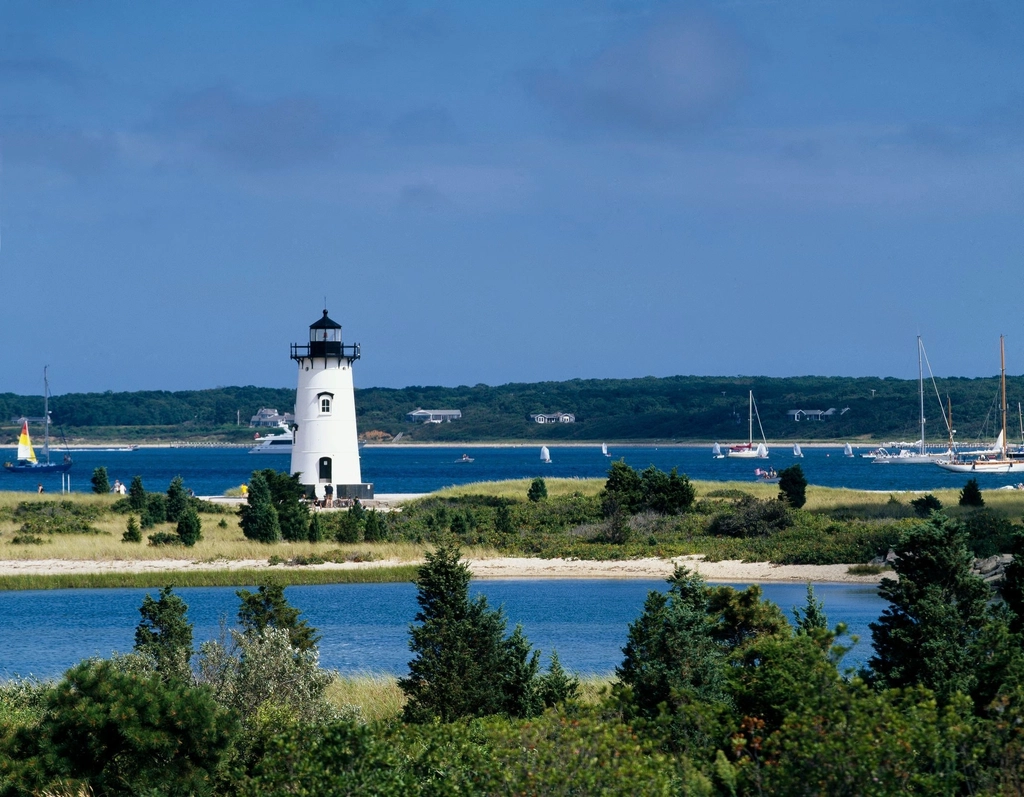
Nôepe, this Island where we live or visit, has been part of the U.S. for 250 years, but it has been a Wôpanâak homeland since time immemorial. On June 23, Vineyard Haven library hosted Brad Lopes, an Aquinnah Wampanoag citizen and the Aquinnah Cultural Center education and public program manager and education director for the Wampanoag Tribe of Gay Head (Aquinnah), in his first presentation this summer on the history of this Island from a Wampanoag perspective. The hour-plus talk was rich in information, and just a small selection of the highlights follow to whet the appetite.
Drawing on oral history and primary-source documents, Lopes began the journey at Nôepe’s origins, when Moshup, a benevolent being of gigantic frame, first created the Island. Lopes then grounded us in Wampanoag culture, which includes matriarchal social customs, a nonhierarchical worldview, and spirituality tied to land, water, cosmos, and one’s ancestors. He delved into one of his guiding questions: How has settler colonialism impacted Wampanoag people on the islands since the 17th century? “One of the biggest things I always want people to walk away with is that settler colonialism is not a singular event that occurs at a particular period of time. It is a structure that acts upon a place and people, and is, unfortunately, something that we still live with.”
European contact began before Thomas Mayhew Sr. purchased the “rights to inhabit” the Island in 1641 from both William Alexander, the second Duke of Stirling, and Sir Ferdinando Gorges, governor of Maine, with colonizers such as Bartholomew Gosnold, Thomas Dermer, and Captain Edward Harlow, an English explorer and slaver who abducted several Wampanoag men and boys, including the notable Nôepe leader Epenow.
The earlier epidemics of European diseases that killed 70 to 90 percent of the Wampanoag population throughout their homelands on the mainland resurged after colonial settlement on Nôepe. Missionaries, including Thomas Mayhew Jr., interpreted this through the lens of their faith and missionary work to convert Wampanoag people to Christianity.
In the second half of the 17th and early 18th centuries, English colonizers sought to purchase land rights from Wampanoag leaders to legitimize their occupation. This often led to coercive and manipulative efforts to dispossess Wampanoag peoples of their land through debt entrapment, land disputes, and court decisions. The remaining major Wampanoag communities on Nôepe included Aquinnah (Gay Head), Nunnepog, Deep Bottom, Chappaquiddick, and Christiantown. Lopes noted, “There was a significant pressure from colonial parties on Wampanoag communities, typically thinking of them as wards — quite literally, as children — over whom the state or the colony had control, which forced Wampanoag communities to adopt English customs and beliefs, including a proprietorship system.”
The 1800s saw continued encroachment on remaining native land, and many Wampanoag people from these communities moved to Gay Head (Aquinnah), and Mashpee on Cape Cod. A series of laws significantly impacted the political and social relationship Wampanoag people had with the commonwealth. The 1862 Massachusetts Act stripped them of their independent tribal governance and reorganized their homeland on Martha’s Vineyard into a state-controlled “Indian district.” This act effectively eliminated their sovereignty, paving the way for the area to be forcibly incorporated as the town of Gay Head in 1870: “When you incorporate, there is detribalization, where you are saying, ‘We recognized you as a tribe before, but now, if I divest of any legal recognition as an Indian community or town, then you are no longer a tribe,’ thereby essentially dispossessing a tribe from the right to be here.”
The allotment process in Gay Head (now Aquinnah), starting in the 1860s, further disrupted the Wampanoag people’s relationship to their land. The commonwealth of Massachusetts sought to divide ancestral tribal common lands into individual private parcels to dismantle the Wampanoags’ communal ownership and traditional way of life. Private ownership also brought property taxes, which led to a shift from a subsistence-based economy to a more capitalist one, either to pay these taxes or to sell one’s land to nonindigenous people.
Lopes said, “In 1974, the Wampanoag Tribal Council of Gay Head, Inc., filed a land suit to reclaim lands that had been taken away from the tribe, and provide a basis for revitalization to protect what was now being threatened by rapid changes in the community.” The settlements of 1983 and 1987 brought about, among other things, the transfer of 325 acres of land into trust, the purchase of 160 acres, and the restoration of a trust and treaty relationship with the U.S. It also, however, largely extinguished any future aboriginal land claim efforts and requirement to abide by town and local zoning laws.
Today, there are 1,500-plus enrolled citizens of the Wampanoag Tribe of Gay Head (Aquinnah), with some 300 able to live on the Island. Among the challenges Lopes mentioned are the growing housing crisis due to high property taxes and a large seasonal population, which further impacts tribal members’ ability to stay on their ancestral homeland.
Looking forward, Lopes said, “I would encourage local and state agencies and organizations to understand that we are a political sovereign entity that needs to be involved in conversations and decisions. There are a lot of opportunities for success left on the table or not considered, because we are not included. I would also encourage the support of the tribe so that there can be more of us here, doing this kind of work.”
Lopes continued, “This leans into equity, which for me is that what is fair is not always equal. I think there are equity issues both for non-native Islanders who have been here for generations, and those like us who are Wampanoag. Why is it that those of us who are being pushed out of the Island are these two groups of people? If we are practicing equity, it would be these two groups, particularly the Wampanoag people, who would first have that level of security and stability. If there are more of us at home, it benefits not only the tribe but everyone on the Island.”
Brad Lopes will present “Nôepe: A Wôpanâak History of the Island” at the Oak Bluffs library at noon and the Martha’s Vineyard Museum at 5 pm on July 11, and at Aquinnah Town Hall on Sept.26 at 2 pm. Lopes has also created “War for the Dawnland: Reimagining King Philip’s War Primary Source Set,” which is available through the Massachusetts Historical Society website.